Showing posts with label Portuguese Cooking. Show all posts

Wednesday, 11 April 2012

Easter in Portugal. Have you ever eaten folar?


Almonds and Easter Bunny Bag 
Eggs and almonds, the Folar (a special Easter Bread (recipe at the end of the article), the Easter Bunny, the whole family together for a special lunch and for some, the Easter Sunday mass. This is how many Portuguese families celebrate Easter.Before Easter, during Lent, the Portuguese avoid eating meat during Fridays for 40 days in respect for the memory of the death of Christ, for it was on a Friday that Jesus was crucified. But on Easter Sunday as we celebrate the feast of the resurrection, the meat returns to Portuguese tables. Walking  the Portuguese Caminho of Santiago da Compostela during the Holy Weekis becoming increasingly popular among the Portuguese. This year, the Espaço Jacobeus Association has distributed 500  credentials to Portuguese pilgrims visiting the tomb of the Apostle James in Compostela.  You can see here more details about this adventure. In Portugal, Easter is celebrated up and down the Country , but it surely has a greater importance in more traditional villages.   There, people will keep their houses very tidy and clean and will be dressed up, waiting for the 'compasso', the visit of the local priest who comes to bless the home and those who live there.   In some villages, it is still customary for the priest and his acolytes to carry a cross, which all the villagers kiss, asking for a blessing.Traditionally, you will find in all homes the traditional almonds and sweets, accompanied by a glass of port wine or liquor as a touch of hospitality to the priest and his companions.  These are traditions that have unfortunately dissipated in the hectic life in the big cities.
In many villages people still celebrate Holy Week with processions of candles at night, or theatrical performances of popular events of Christ's death.


The Folar Bread
The tradition of FOLAR, the Easter Bread.

The Folar Bread is a typical  present given during Easter in Portugal. It is this bread that godparents used to give their godchildren at Easter to break the fasting period.  

The
 bread was also seen as a sign of affluence, during the compasso, the priest would collect the Folar from the houses he visited. . Not forgetting, of course, that being made of wheat, it represents the basic element that makes food, food!
Most dictionaries flag the origin of the word 'Folar from the Latin "floralis".  The authors suggest the Germanic 'flado' which means 'honey cake' as the probable root for the name Folar or, as some other authors claim,  Folar comes from the French 'poularde'.   

Folar
 is defined as a cake-shaped dough nesting an orange-colored egg on the top.


The bread, which is also known as cake, symbolizes the nestand the eggs, the  generation of a new life, fertility.  When you present someone with a Folar bread, you are wishing this person happiness and prosperity.  

In the Portuguese villages, the bread is a very rustic bakery product whereas in the cities, it is a product of "pastelaria" with some improvement of flavor, colour, texture and presentation. and as with everything in Portugal, when it comes to cooking, each region of the country will feature its Folar prepared in a different way.   As a guide, grandmothers would prepare them using wheat flour (well sifted), a dozen eggs per each quilo of flour, butter, yeasts, olive oil, salt.   You may use as a filling the meat of beef, lamb, chicken, sausages etc. See below one - of the many - recipe for a traditional Folar Bread.
The
 Folar does not require much ingenuity, just some patience (it takes about 2 ½ hours until done). 
You can opt for a traditional bread, or make a typical Transmontano recipe (stuffed with sausage typical of the region) or make a Catanhede recipe; the dough is like the traditional version, but the centre  has Olive Oil and the shape of the bread is slightly different.

You will need the following ingredients


500g flour
125g sugar
125g of butter
4 eggs
25g of baker's yeast
0.5 dl of milk, 
lemon zest  
salt to taste  
3-4 boiled eggs.


Then you lay hands on the dough. Sift the flour, dissolve yeast inwarm milk BakerPlacethen the flour in a bowl and combine all the ingredients in the centerKnead well until dough is smooth and homogeneousCover with cling film and let rise (doubling its volume).

Sift the flour, dissolve the yeast (if using biological yeast) in warm milk.  Put the flour in a bowl and combine all the ingredients in the centre. Knead well until dough is smooth and homogeneous. Cover with cling film and let rise (doubling its volume).
Cut
 then into pieces of 400 grams each and form a ball and leave them to rest for 30 minutes. Set some dough aside, wrapped in cling film, to form the strips that will "hold" the boiled egg - see the picture below.  Add some milk to a beaten egg and use this mixture to brush the dough.  Add the boiled eggs (whole!) in the center of the dough, pressing them down gently.

Brush
 and bake the dough in a preheated oven at 200 ° C.   Do not get distracted.  After 15 minutes, it is necessary to lower the oven temperature to 180 ° C.    Bake it for more 10 minutes.   It is ready!
Bom apetite!


Want to read more?  Find below some nice websites on the theme: 
Sources: http://viadeiportoghesi.blogspot.co.uk/2008/03/pscoa-em-portugal-por-marta-sofia.html ,  http://www.dn.pt/inicio/portugal/interior.aspx?content_id=1192678 , http://praca.porto24.pt/2012/03/30/aprendemos-a-fazer-um-folar-tradicional-e-contamos-lhe-tudo/?utm_source=rss&utm_medium=rss&utm_campaign=aprendemos-a-fazer-um-folar-tradicional-e-contamos-lhe-tudo 

Thursday, 24 November 2011

And the British taste Portugal. And they like it!


"The British public begun to realize that Portugal is not just sun, sea and good weather but also a Country that holds other attractive aspects like food, nature, cultural tourism and a number of other attractions and services that the British tourists are recently getting to know better," said Cecilia Meireles, Portugal Tourism State Secretary.  


Traditionally, British tourists enjoy areas of the Algarve region and Madeira island but the tourism campaign of other regions begin to deliver results.
"Although there is a very substantial tourism growth  in these regions, the truth is that there are other regions, such as the Alentejo and the center of Portugal that are beginning to feel the effect of our campaign, as they are receiving more British tourists nowadays.

Below, the video for 2011 tourism promotion, with the campaign: "The Beauty of Simplicity"  It is quite obvious that the Portuguese are decided to showcase their country as a cultural and adventure spot just as well as having fantastic beaches and good weather.


After a fall of 2.3 percent in overnight stays between 2009 and 2010, the number of British travellers rose 18.5 percent from 2010 to 2011, more than double of the national average (8.1 percent).
The Portuguese Tourism Office launched last year the campaign  "Prove Portugal," (Taste  Portugal) as a way to enrich and differentiate Portugal attractions from the other 'Beach and Sun" destinations in Europe.  This is definitely an appeal for the food, the wine and an attempt of putting Portugal on the map as the country that has the best fish in the world.
Watch below the promotional video of the campaign:


But the tourist must observe that there are other attractions and new tourism segments, such as the nature and new trends such as bird watching, besides the strong cultural appeal.  Watch the video below about birdwatching in southern Portugal.


Original article adapted and modified by C. Jacobs. 

Saturday, 19 November 2011

Faro, Portugal - What to do in there?

First time I visited Portugal I stayed in the Algarve and spent 10 days travelling their cities, villages and hamlets from Faro to Sagres.  I collected some good experiences and could enjoy wonderful food and learn a lot about the city's past and important role in the South of Portugal just by strolling on the streets, going inside the museums and churches. 


It is a shame so many tourists only go to Faro because of Faro International Airport, they don't know what they are missing! Below, some pictures I took during my trip. Hope to see you there soon! 


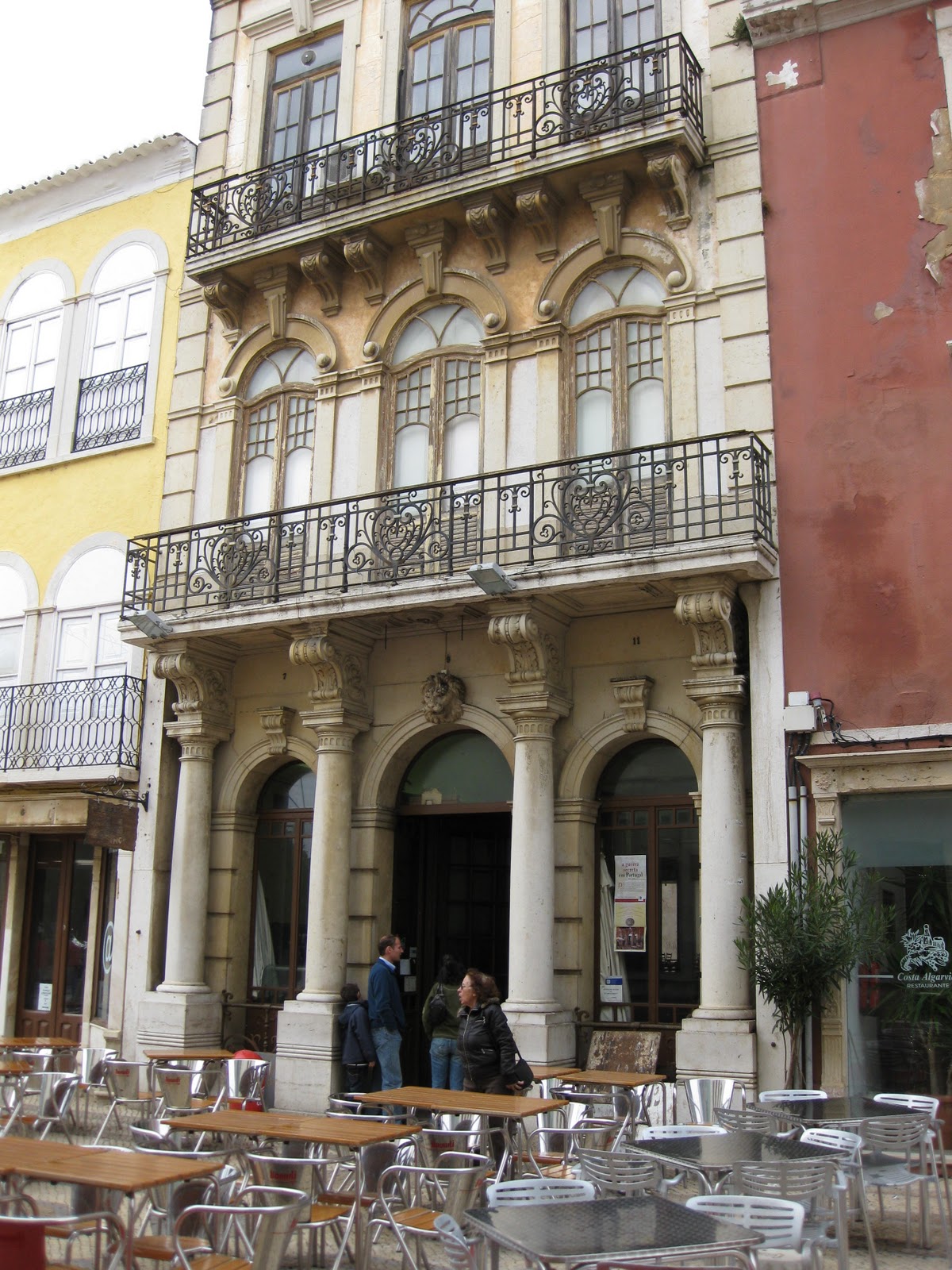
One of the many Shopping Streets in Faro


Café Aliança is the oldest café in town and of huge cultural traditions. It occupies the ground floor of the building built by Jose Pedro da Silva constituting on the whole an interesting testimony to the revivalist architecture.  In addition to the main entrance and another at the rear, it also features a side entrance that allows access through the kiosk.
Café Aliança, which recently celebrated one hundred years, is amongst the three oldest cafés in the country, along with A Brasileira in Lisbon, and the Majestic in Porto.

Known for its social gatherings, the café was a meeting point for distinguished people such as Fernando Pessoa, Marguerite Yourcenar and Simone de Beauvoir.


Capela dos Ossos

"The Capela dos Ossos, or Chapel of Bones, is one of the most eccentric and unusual attractions in Faro. This chapel was built in the nineteenth century and is lined with human skulls. Over 1200 human skulls, in fact. This makes it one of the most morbid attractions in the area, but also the one that is the most interesting. Aside from this grim attraction, the chapel is also known for its beautiful Gothic and Renaissance architectural style which should be of interest to anyone who is a fan of nineteenth century architecture or history." (source: click here)


Indeed this Chapel of Bones is something really weird!  Check this other photo I took 


Arco da Vila, one of the 3 medieval Portal Entrances of the city 

In the Historic Centre of Faro is very compact -  you can visit basically all the important spots in one day and besides that, you can also go on a boat tour of the beautiful Ria Formosa.

"Since the mid-eighties, the Ria Formosa has been a nature reserve, where sea water birds find protected breeding places and many fish species of the Northern Atlantic as well as other marine organisms reproduce." (via Algarve Portal)

You also have the Faro Archeological Museum, Maritime Museum, The City Cathedral etc.
Don't forget to enjoy some hot chestnuts sold on the streets of Faro! 
  
And if you speak Portuguese or study the language, Faro is an excellent place to try what you know.  Unlike Albufeira, Lagos and other popular tourist spots in the Algarve, there you walk on the streets feeling the very almost intact Southern Portuguese spirit - the shops have their signs written in Portuguese (bless!) and everyone in the bars, cafés and "pastelarias" speaks Portuguese.   :)     

Next time you visit the Algarve, don't miss out Faro!  And if you live near Southend on Sea, you can fly to Faro from Southend Airport from April 2012 !  Woo-hoo ! 


Sunday, 13 November 2011

What kind of food do people in Brazil eat?


This is a recurring question I am asked by the people I meet and students.  They often ask me to talk about Brazilian food and what it is like but this is not an easy task due to its huge diversity but we can start our "culinary trip" from the most delicious - in my opinion - variety: The Afro-Brazilian Cuisine. 

The food in Brazil is a 'hot pot" of all cultural influences we have received along the centuries of mass immigration in the territory, as for example, back in the sad slavery times, the Portuguese Cuisine in Brazil was mixed up with the African cooking traditions and suffered adjustments as certain ingredients were different and sometimes non-existent.  


"The Africans arrived as slaves and were treated as sub-humans. The women were responsible for the feeding of the white masters and began to adapt their cooking ingredients according to the supplies available in the new land". says Leomar Borges, the coordinator of Special Diversity Projects at the Municipal Secretary of Restoration, in Salvador, Bahia (Brazil). 
"In that time, since
 
the supply and diversity of food was poor, the African women had to adapt their knowledge of African cooking to the local products, having to improvise, create, reinvent their cooking. 

Seeds,
 roots, leaves, fruits and everything that could be used in response to the  the shortage of food in the slaves quarters and in the big farms were used and this mix brought new flavours in the local  art of cooking and thus, the very Brazilian cuisine. "The African cuisine enhanced both the Indian and Portuguese cuisine, thus creating the  Afro-Brazilian cuisine"


The oldest African dish in Brazil, carurú , dates back to the 1600s. It is a spicy stew made with smoked fish or shrimp, quiabo (okra), onions, dendê (palm oil), and peppers. In the twenty-first century, the African influence on ingredients and cooking techniques still thrives, especially in the northeastern state of Bahia. (Food By Country)


Feel hungry now? 

You don't need to be in Brazil to have a go on some delicious Afro-Brazilian dishes and see for yourself how tasty they are!  If you are in London, visit this page to see hundreds of Brazilian restaurants around the city and If you are travelling to Portugal, you will surely come across many Brazilian restaurants or Brazilian dishes in Portuguese restaurants and eateries.  

Check the video below to learn more about the variety of taste and colours that make up our national dishes: