Showing posts with label Britons in Algarve. Show all posts

Thursday, 24 November 2011

And the British taste Portugal. And they like it!


"The British public begun to realize that Portugal is not just sun, sea and good weather but also a Country that holds other attractive aspects like food, nature, cultural tourism and a number of other attractions and services that the British tourists are recently getting to know better," said Cecilia Meireles, Portugal Tourism State Secretary.  


Traditionally, British tourists enjoy areas of the Algarve region and Madeira island but the tourism campaign of other regions begin to deliver results.
"Although there is a very substantial tourism growth  in these regions, the truth is that there are other regions, such as the Alentejo and the center of Portugal that are beginning to feel the effect of our campaign, as they are receiving more British tourists nowadays.

Below, the video for 2011 tourism promotion, with the campaign: "The Beauty of Simplicity"  It is quite obvious that the Portuguese are decided to showcase their country as a cultural and adventure spot just as well as having fantastic beaches and good weather.


After a fall of 2.3 percent in overnight stays between 2009 and 2010, the number of British travellers rose 18.5 percent from 2010 to 2011, more than double of the national average (8.1 percent).
The Portuguese Tourism Office launched last year the campaign  "Prove Portugal," (Taste  Portugal) as a way to enrich and differentiate Portugal attractions from the other 'Beach and Sun" destinations in Europe.  This is definitely an appeal for the food, the wine and an attempt of putting Portugal on the map as the country that has the best fish in the world.
Watch below the promotional video of the campaign:


But the tourist must observe that there are other attractions and new tourism segments, such as the nature and new trends such as bird watching, besides the strong cultural appeal.  Watch the video below about birdwatching in southern Portugal.


Original article adapted and modified by C. Jacobs. 

Saturday, 19 November 2011

Faro, Portugal - What to do in there?

First time I visited Portugal I stayed in the Algarve and spent 10 days travelling their cities, villages and hamlets from Faro to Sagres.  I collected some good experiences and could enjoy wonderful food and learn a lot about the city's past and important role in the South of Portugal just by strolling on the streets, going inside the museums and churches. 


It is a shame so many tourists only go to Faro because of Faro International Airport, they don't know what they are missing! Below, some pictures I took during my trip. Hope to see you there soon! 


One of the many Shopping Streets in Faro


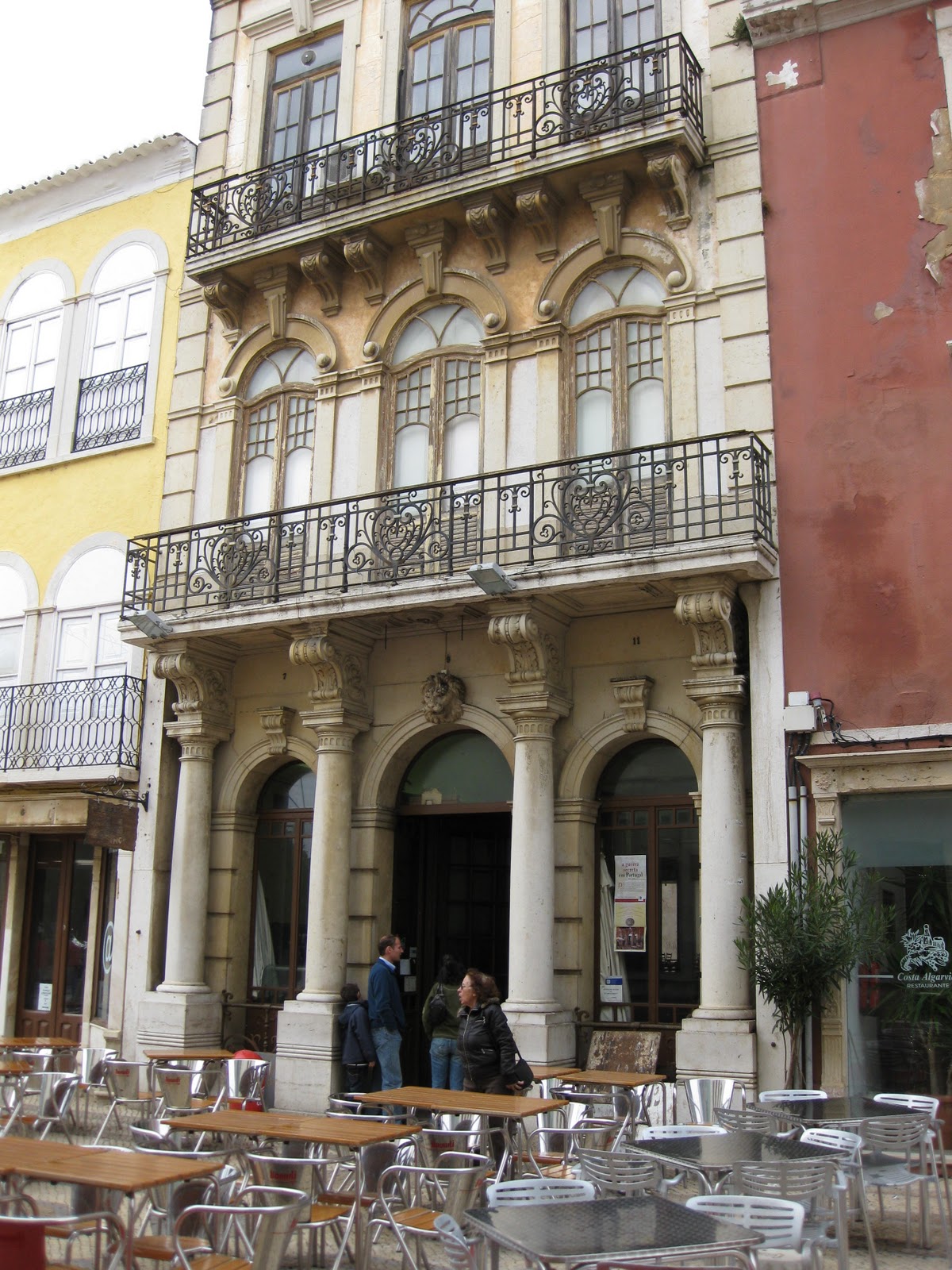
Café Aliança is the oldest café in town and of huge cultural traditions. It occupies the ground floor of the building built by Jose Pedro da Silva constituting on the whole an interesting testimony to the revivalist architecture.  In addition to the main entrance and another at the rear, it also features a side entrance that allows access through the kiosk.
Café Aliança, which recently celebrated one hundred years, is amongst the three oldest cafés in the country, along with A Brasileira in Lisbon, and the Majestic in Porto.

Known for its social gatherings, the café was a meeting point for distinguished people such as Fernando Pessoa, Marguerite Yourcenar and Simone de Beauvoir.


Capela dos Ossos

"The Capela dos Ossos, or Chapel of Bones, is one of the most eccentric and unusual attractions in Faro. This chapel was built in the nineteenth century and is lined with human skulls. Over 1200 human skulls, in fact. This makes it one of the most morbid attractions in the area, but also the one that is the most interesting. Aside from this grim attraction, the chapel is also known for its beautiful Gothic and Renaissance architectural style which should be of interest to anyone who is a fan of nineteenth century architecture or history." (source: click here)


Indeed this Chapel of Bones is something really weird!  Check this other photo I took 


Arco da Vila, one of the 3 medieval Portal Entrances of the city 

In the Historic Centre of Faro is very compact -  you can visit basically all the important spots in one day and besides that, you can also go on a boat tour of the beautiful Ria Formosa.

"Since the mid-eighties, the Ria Formosa has been a nature reserve, where sea water birds find protected breeding places and many fish species of the Northern Atlantic as well as other marine organisms reproduce." (via Algarve Portal)

You also have the Faro Archeological Museum, Maritime Museum, The City Cathedral etc.
Don't forget to enjoy some hot chestnuts sold on the streets of Faro! 
  
And if you speak Portuguese or study the language, Faro is an excellent place to try what you know.  Unlike Albufeira, Lagos and other popular tourist spots in the Algarve, there you walk on the streets feeling the very almost intact Southern Portuguese spirit - the shops have their signs written in Portuguese (bless!) and everyone in the bars, cafés and "pastelarias" speaks Portuguese.   :)     

Next time you visit the Algarve, don't miss out Faro!  And if you live near Southend on Sea, you can fly to Faro from Southend Airport from April 2012 !  Woo-hoo ! 


Sunday, 13 November 2011

José Saramago and his new novel, Claraboia

“Clarabóia” (Skylight), a previously unpublished novel written by Portuguese Nobel laureate José Saramago has finally reached the bookstores, after having been tacitly rejected by publishers in the 1950s. The now posthumously published novel was one of the first he ever completed, and after its overall rejection Saramago made the drastic decision to give up pursuing a career in writing. Although he later changed his mind, he never wanted “Clarabóia” to be published while he was still alive." (via Portugal Daily View)

When he died last year, José Saramago, aged 87, was considered the greatest prose writer of the Portuguese language. Winner of the Nobel Prize in Literature in 1998, Saramago consolidated a career that was basically built during maturity. The praise the writer had gathered for his personal and unique writing style, Saramago's politician side was distrusted by the world. Communist and a fierce critic of the consumer society and ideology, Saramago made from his skepticism, a trademark.

Thus, Saramago was characterized as a mature man, firm in convictions and defined in aesthetic terms. Saramago invented a literary mode, made of long phrases with a peculiar punctuation in which the dialogues overlapped with digressions and reflections, merging several voices in the same paragraph. The art of the writer was on building such a complex text with absolute dominion of the rhythm and flow. It was always easier to read Saramago than explaining it


Picture  from Instituto Português de Cultura

Death has the power to consolidate myths. Saramago, was the writer who had had his "debut" at this peak of his age and intelligence, after a lifetime of many practical activities, from the realm of locksmiths to the partisan journalism. The launch of the novel Claraboia will change that story. The book is from 1953, when the author was not even 30 years old and was written five years after the Terra do Pecado, written when he was only 25 , in 1947, with little repercussion. 


Because of that, the interest on the early work of the author may earn another inflection: Was Saramago already a Saramago in the early 1950? Claraboia brings a positive response in terms of world view and in respect of the man he was, while it offers us hints of his art. The style is different, but the writer was already there.  (this article was originally published in Divirta-se, in Portuguese Language)

If this is the first time you read about Saramago and you would like to know more about this great writer, visit his dedicated page on the Nobel Prize website and if you read in Portuguese or in Spanish language, his website is the right place to be.

Kames Wood, from The New Yorker, also reviews one of Saramago's book "Death takes a holiday"   and by clicking here, you will be taken to Amazon Bookshop, where you can purchase one of Saramago's works, in English.