Showing posts with label Learning Portuguese. Show all posts

Monday, 30 April 2012

The beautiful "Maia" tradition in Portugal


The name of the fifth month of the Julian calendar, the month of May (in Latin, Maius and Maio, in Portuguese language) probably had its origin in the word  Maia, the mother of Mercury.


In Roman tradition,  Maia  personified the awakening of nature in the spring and is also the goddess of fertility and the projection of vital energy.   Maia is symbol of spring.   

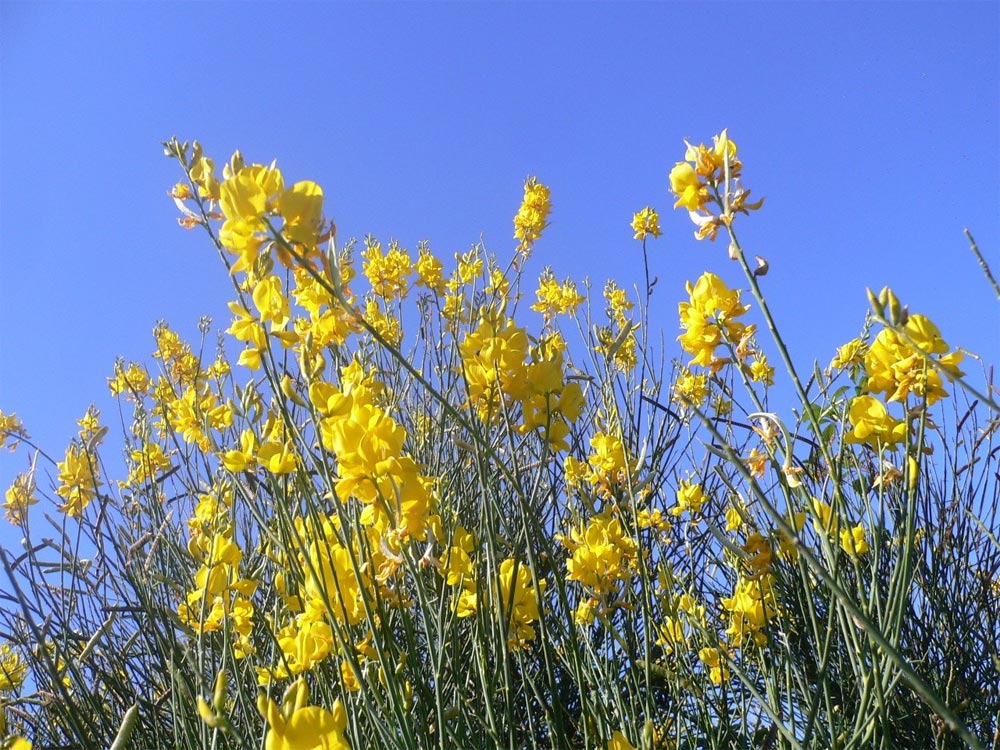
In Portugal it is a tradition to decorate the doors of houses and windows and other places with common gorse flowers.  The tradition requires that the locks and latches on all windows and external doors of the houses are decorated with branches of gorse in bloom, called "Maia". Farmers should also be vigilant and place the flowers inside the animal corrals.
If doors or windows do not hold a branch of Maia,  it is believed that "the devil will come and suck the blood of those who dwell there."

This is a very old tradition  throughout Portugal, especially in the north.  Some scholars say it has to do with pagan rites associated with spring and fertility of the land and animals.  There are also those who say that this tradition may have religious roots as as story goes that Our Lady, during her the flight into Egypt, with Baby Jesus and Saint Joseph, had sowed gorse seeds along the way so that they could find their way back when returning from there. 

Another legend goes that by the time of Passover, when Jesus was in Jerusalem, the Jews marked with gorse branches the house where he was staying so that the soldiers could identify it later on and arrest him.  However, on the next day, all doors and windows of the city were decorated with flowers of gorse, making it impossible for the soldiers to find Jesus's location.  


In the Alentejo region, with particular emphasis on Beja, the "Maia" are girls who dress in white, adorned with flowers in their heads. They gather on the streets and sit on chairs  adorned with roses while other elder girls carrying small trays in hand, ask passers-by : "Sir, give some money for the  Mayan."  -  “Meu senhor, um tostãozinho para a maia"


In the Algarve, in almost all the houses it is customary to get a big man made of straw, rye, bran and rags and dress it in  white and then surround it with flowers. It is the "Maia" placed in full view of passers by.

This habit of putting yellow gorse at the doors, windows and balconies is not lost, as well as the enduring habit of making straw dolls.   However, the tradition of girls dressed in Maia has become rare nowadays.  However, on the first day of May, there are other traditional rituals such as eating chestnuts with the aim of cast the evil away.  


Some nice vocabulary to prepare you for the Maia Rituals: 

Flower - flor 
Gorse - giestas
Bunch - ramalhete
Door - porta
Window - janela
chestnuts -  amêndoa
Spring - primavera

Wednesday, 4 April 2012

Portuguese: 4th easiest language to learn?


What makes a language easy?  A simple and logical grammar engineering?  The number of words?  Pronunciation?  Similarities between the new language and your native language?  

Does it depend on what native language the student speaks?   So, for Spanish speakers, learning Portuguese is easier than it may be when learning English?  Is this true? 


The Editor of linguim.com  listed Portuguese as the 4th easiest language to be learned by an English speaker.   


Although there is no hard evidence provided by the editor to support this claim, his/her thoughts on the theme are very interesting:  

"Portuguese is yet another romance language that shares similarities with English, yet contains fewer prepositions. However, Portuguese prepositions do not always mimic their English counterparts, so a slight learning curve is in store. Learning to pronounce Portuguese words is usually easy for English speakers; however some of the vowel sounds may take some getting used to. In many languages learning how to ask a question in proper context is difficult, but posing a question in Portuguese is as easy as speaking the words. Individuals that have already learned some Spanish may find it even easier to learn Portuguese.  Most people rank Portuguese as easier to learn than French, but not as easy as Italian or Spanish. It is important to note that there are two very different variations of Portuguese – Brazilian and European. Of the languages on this list, Portuguese shares the most similarities with Spanish, but most agree that Portuguese pronunciations are more difficult."


One thing I tell my students when they start taking Portuguese Lessons with me is that once they feel comfortable with the Portuguese language, they will notice that most of the words in Spanish will not seem so unknown.

Spanish and Portuguese are "sister" languages,  although Portuguese pronunciation swings more towards French and Catalan whereas Spanish pronunciation will be closer to Italian language.    Portuguese has a wider number of phonemes (the sound units in a language) than Spanish does, therefore, it is easier for a Portuguese speaker to understand a Spanish speaker than vice-versa.   


Doubt it?  


So ask a native Spanish speaker to say this pair: "meu avô; minha avó"  and then, ask a native Portuguese speaker to do the same.  Can you spot the difference?   If the Spanish speaker likes football, ask him/her to say the name of the best footballer in all times.   No, not Maradona!  It is Pelé!   ;p  Now ask a Portuguese speaker.  Pay attention to how the "é", in Pe, will be pronounced.   These are just some quick examples, of course. 


Spanish and Portuguese also share loads of similar words, the cognates, but with different meaning, the famous false-cognates, or, "false friends": 
My favourite false-friend is the word: "esquisito"  ---  The most common meaning of Esquisito in Portuguese is "weird", "strange" , in Spanish (written - exquisito) it means "excellent", "delicious".   So you can imagine what a confusion it is if you decide to compliment the food your Portuguese host has prepared to you by saying: "Oh, que exquisito!"


Check some false-cognates Portuguese -Spanish below:  


                        Portuguese                                                 Spanish

Ninho: bird nest Niño: child, boy


Engraçado: funny, graciousEngrasado: greasy 


Borracha: eraser(rubber)Borracha: drunk

Esquisito: rare, weird, strangeExquisito: excellent, delicious
Fechar:to close, shutFechar: to write the date
Ganância: ambitionGanancia: profit, earning
Oi: HiHoy: today
Latido: the "barking" of a dogLatido: heart beat
Ligar:to call on the phone, to link, matchLigar: to flirt
Logro: cheatLogro: success
Mala: valise.Mala: má.
Oficina: mechanics, garageOficina: office
Osso: bonesOso: bear
Polvo: octopusPolvo: dust
Prender: to deter, arrestPrender: to lit 
Rato: mouseRato: short period of time
Reto: straight (no curves)Reto: challenge
Risco: dangerRisco: cliff
Saco: Purse, Sack, BagSaco: jacket (with a tie) 
Salada:saladSalada: salty 
Solo: ground, earth, soilSolo: alone, on your own
Taça: special glass for winesTasa: tax


Source: http://transportuguese.com/blog_traducao/algumas-diferencas-entre-o-espanhol-e-o-portugues/

Can you identify some English words in there as well?  Like, "salad" for salada, in Portuguese? So now you know that "salada" means salty, in Spanish.  


Next post, I will explore a little bit the differences between European and Brazilian Portuguese. Don't miss it! :)  


Do you have a twitter account?  Add our account, so you don't miss any new article in Em Português!, blog:  @portugueseondem  
   

Friday, 16 March 2012

Brazilian Portuguese - the best language to learn?

This week, Helen Joyce, "The Economist" magazine correspondent in São Paulo, Brazil, wrote an article about how Brazilian Portuguese is "the" language to learn.   Do you agree with her? 


São Paulo is a huge city, opened 24 hours, 7 days a week, in there you meet people from all regions of the country, the city was made up by immigrants from many parts of the world.   Nowadays - just like in a distant past,  Portuguese is not the only language heard on its streets.   Last time I visited my hometown, in 2010, I could hear English, Spanish, French, Dutch...   


Helen Joyce praises the language and the country for its size, natural resources, people and present financial situation.  The latter, according to her, is already a good reason to start your course on Portuguese language.  


Joyce says: 
"You won’t need a new alphabet or much new grammar, though you may find the language addicted to declensions and unduly fond of the subjunctive. You’ll learn hundreds of words without effort (azul means blue, verde means green) and be able to guess entire sentences (O sistema bancário é muito forte: the banking system is very strong). With new pronunciation and a few new words you’ll get around in Portugal and parts of Africa. If you speak Spanish, French or Italian, you’ll find half the work is already done — and if not, why not try? With Portuguese under your belt you’ll fly along".
Of course Joyce's views about the language "per se" are simplistic, but her approach to language learning is fantastic.    One can easily feel her intention to compare Brazilian Portuguese to its BRIC's counterparts: Russian, Mandarin, Hindi...   For an English speaker, it is quite obvious that learning Portuguese will be more straight-forward than learning those other languages, due to their Indo-European  root, English's Latin influences and, of course, the western culture both languages carry.    


From some years on, I have noticed during my daily routine as a Portuguese teacher that more people are choosing Portuguese as their second language than ever;  be it for personal or professional reasons.    I could observe that some of them even start learning the language as a tool to stand out professionally, as more and more multinational companies are doing business with Brazil, opening offices in there, buying shares, investing etc.   


On the other hand, I also have students who learn European Portuguese, and this is also a "hit" as many English  own beach properties in Portugal or Madeira and also, because many marry Portuguese partners.  I love the sound of European Portuguese and I am addicted to Lisbon.   Teaching European Portuguese is completely different from teaching the Brazilian variety.  As Helen Joyce highlights, the sounds and vocabulary do play an important part in distinguishing one type of Portuguese from the other.   But the differences go further. phrases are built in different ways, they certainly have a distinct "tempero".  


Click here to read Helen Joyce's full article and don't forget to vote for the language you think is "the"one to learn! 


And if you want to give this language a go, check my website: www.PortugueseOnDemand.co.uk for further information on how to study it from home or in your company.  


Saturday, 4 February 2012

What is a "samba de enredo" about? Carnival time!

Carnival is approaching rapidly and the cities where the event is celebrated are rushing to get everything ready on time!

Carnival in Rio and other cities is a serious business and preparation begins right after the Carnival season finishes, after all, organizing a 4,000+ parade formed by amateur dancers and choreographers, and the making up of a theme song, costumes, floating cars, drummers is not something that can be put on hold until the last minute.  
On this Carnival season, I am going to publish some articles on the theme, portraying not only the famous Carnival of Rio de Janeiro, but also the many forms of Carnival celebrations that happen in Brazil and in other parts of the world.  

To start with, how about some new "Carnival-related" words for our vocabulary? We start with the word SAMBA DE ENREDO and in the next articles you will meet other important vocabulary for the Carnival season.  

Let's keep in mind that vocabulary learning is not only learning a bunch of words and their usage, but mainly, to learn what the word mean in cultural/historical/social aspects.  This is how we can increase rapidly the number of vocabulary we are able to study and not to forget, a common complaint students make.  

Here we go:

Samba-enredo or samba de enredo
 – the Samba Theme, they help to understand the theme, so they have to be clear, poetic and show good taste.

But what is all the fuss about it?  And why is it so important for a carnival parade?

Each school parading in Rio or São Paulo competitions must present a "samba de enredo" and one of the things the judges take into account when marking the scores for each presentation is the participants engagement with the song.  Everyone must sing the theme.  When the samba de enredo is ready, by the middle of the year, the schools launch the tune in CDs so that people can buy it and rehearse the song.  It must be catchy, with repetitive chorus, easily memorable and 


The samba de enredo is chosen at the beginning of each year by the carnavalesco (professional who is responsible for the production of the parade of the samba school he works for) and the president of the samba school.
They create
 a blurb that explains the topic of the parade and  the samba de enredo must be made based on it​​.   They also plan the order of the floating cars during the parade and the different sections, according to the number of people.   The dispute to choose the song for the samba de enredo usually happens at the school grounds and a evaluation panel is assembled to evaluate each song presented by the samba writers. The panel is composed by "old school" carnival experts, older "carnavalescos" and important people from the community where the school is inserted.  


The parades of samba schools in Rio Carnival has immortalized songs that all Brazilians know to sing.  Neguinho da Beija-Flor, a renowned samba composer, says:  a good samba de enredo is responsible for 70of the successful performance of a school."


The school
 receives a large number of different compositions of samba songs. They are selected and performed several times on "decision day", at the school for the jury and the community to define which one stirs the audience. The one to win is the one that most excites the crowd!


Based on articles from the following websites:
http://www.sesctv.org.br/destaque.cfm?id=5992&destaque_id=4
http://riotimesonline.com/brazil-news/rio-entertainment/rio%E2%80%99s-carnival-glossary/
http://www.homesinrio.com/carnival-in-rio.htm

Thursday, 2 February 2012

Defenestrar: a very Portuguese verb


Portugal has scrapped 4 holidays in 2012.  
The government drops the holidays of Republic Day (5 October), Independence Day (December 1)Corpus Christi (mobile holiday this year to June 7) and the Assumption of Our Lady (August 15). The proposal is part of the draft labour reform that will be analyzed by the social partners next week and then back by the Council of Ministers.
For many people in Portugal, having the two civil holidays cancelled is understood as a provocation, an offensive way to underestimate the power of people:  the abolishment of the monarchy and the retake of Portugal from the Spanish hands.   Nothing could be as offensive.

A blogger says:

"It is a tremendous symbolismthat the year of Troika occupation will be the last year Portugal will celebrate its independence."
Source article
Do you know what happened on this day, on the December 1st in 1640? 
On December 1st, 1640, Miguel Vasconcelos was the Secretary of State (prime minister) of the Duchess of Mantua, vice-queen of Portugal, on behalf of King Philip IV of Spain (Philip III ofPortugal).  He was hated by the people, being Portuguese, for collaborating with the Philippine representative of Spanish domination. He was the first victim to be thrown out of the window.   Yes.  This was how the Portuguese people decided to oust the enemies of their land.  .

After entering the palace, the conspirators hunted for Miguel Vasconcelos, but there was no sign of him anywhere in the Palace: they had walked the halls, the offices,the chambers of the minister, and nothing.  It turn out that Miguel de Vasconceloswhen he realized that he could not escape, got inside a closet and shut himself inside with a gun. 

What finally 
denounced he was hiding there inside was actually the size of the cabinet: the fugitivetrying to move there inside to change his positionsquirmed inside, causing a loud noise due to the amount of paper, boxes etc which were inside the cabinet.  The conspirators heard it all and started to kick the cabinet's door, finally having it opened and shooting Vasconcelos.   Then, they grabbed the corpse and  threw it out the window.
The body fell in the middle of a mob who started to revenge on it all their wrath, committing real atrocities and after that,  being left at the crash site to be licked by dogs, a symbol of pure debauchery.
Another blogger says:
"This is the last year when December the 1st and the Republic day will be national holidays.  Interestingly these are two dates supported by popular revolutions. Maybe for this government, revolutions are neither good to remember nor to celebrate."
Source article 
Vocabulary:

The special verb (action word) to learn from this story is the verb that defines the "spirit" of the revolution on the December 1st in Portugal:  DEFENESTRAR - to violently throw through or out of the window.
Revolution - Revolução 

Palace -  Palácio

Cabinet (furniture) -  Armário

Troika  -  The term Troika has been widely used in Greece (Greekτρόικα)[1] and Ireland,[2] and now Portugal (Portuguesetroika)[3] to refer to the presence of the European UnionEuropean Central Bank, and International Monetary Fund in these countries since 2010 and the financial measures that the three governments have been forced to take.  (wikipedia)